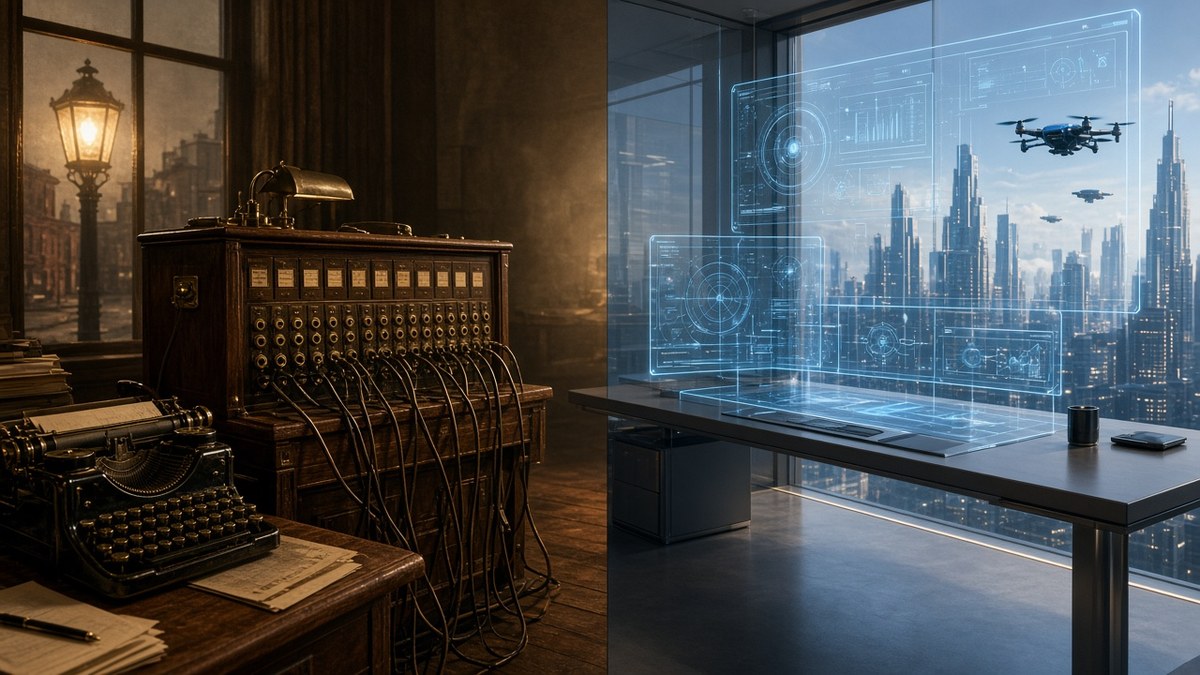
Step into a city street of the 1920s and you would meet workers whose jobs have almost vanished: the woman at the switchboard, the man with the long pole at dusk, the iceman's wagon. These jobs from 100 years ago did not simply disappear; they evolved into some of the most interesting careers of 2026. JobzSeekers maps six of them, then and now.
1. Telephone Switchboard Operator
In the 1920s, telephone calls were connected by hand, and companies employed hundreds of thousands of operators, most of them women. Automatic exchanges replaced the role, but the skills of calm, fast problem solving live on in customer experience specialists and contact centre leaders. Future version: AI conversation designer.
2. Lamplighter
Lamplighters walked city streets at dusk lighting gas lamps and returned at dawn to put them out. Electric lighting retired them, though a few cities still keep the tradition for heritage. Future version: smart city lighting engineer, designing sensors that dim and brighten streets automatically.
3. Elevator Operator
Before automatic controls, uniformed elevator operators drove lifts in hotels and office towers. The job faded after the 1950s. Future version: robotics and automation technician, keeping the machines that move people and goods running safely.
4. Jobs From 100 Years Ago in Science: The Human Computer
In the 1920s, computer was a job title. Teams of skilled mathematicians, many of them women, calculated by hand at observatories and research centres. At NASA, Katherine Johnson computed trajectories for early spaceflights, and John Glenn reportedly asked that she verify the electronic computer's numbers before his 1962 orbit. Future version: data scientist and machine learning engineer.
5. The Iceman
Before home refrigerators were common, icemen delivered blocks of ice cut from frozen lakes or made in ice plants. Electric refrigerators ended the route. Future version: cold chain logistics manager, moving vaccines and fresh food across continents.
6. Cinema Organist
In the silent film era, theatre organists played live scores to match the action on screen. Talkies arrived after 1927 and the role faded. Future version: immersive sound and experience designer for films, games and venues like Las Vegas's Sphere.
The Future Angle: Jobs of 2126
Looking at jobs from 100 years ago shows a clear pattern: technology retires tasks, not talent. The switchboard operator's empathy, the human computer's precision and the organist's timing all found new homes. To prepare, build skills that travel. See which companies are hunting for them in why corporates compete for AI visionaries, and explore what top roles really pay.
Visit the future: send us your idea
Which job of 2026 will look as vintage as a lamplighter by 2126? Send JobzSeekers your idea. Send us your idea.
FAQ
What jobs from 100 years ago no longer exist?
Many jobs common in the 1920s have nearly disappeared, including telephone switchboard operators, lamplighters, elevator operators, human computers, icemen and silent cinema organists. Automation, electricity, refrigeration and sound films replaced the tasks, but the underlying skills moved into new careers.
Who was Katherine Johnson?
Katherine Johnson was a NASA mathematician who calculated spaceflight trajectories by hand. She is celebrated for checking the electronic computer's numbers before John Glenn's orbital flight in 1962, reportedly at his request. She received one of America's highest civilian honours from President Barack Obama in 2015 and inspired the film Hidden Figures.
How can I prepare for jobs of the future?
Focus on skills that transfer across technologies: communication, problem solving, data literacy, creativity and adaptability. Historic jobs show that machines replace tasks, while people who learn new tools carry their strengths into new roles. Short courses and hands on projects help you move with the market.
Keep reading
- 7 Ancient Careers That Still Pay in 2026, From Scribes to Star Navigators
- 7 Legendary Celebrity Paydays in History, From Jenny Lind to Charlie Chaplin, in 2026
- Hired by a Billionaire: The Jobs Closest to Extreme Private Wealth
Sources named in text: AT&T archives; NASA; Smithsonian National Museum of American History; Theatre Historical Society of America.